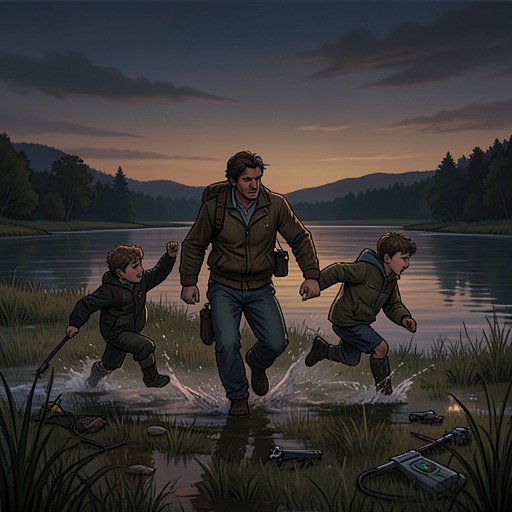
Scott is attacked by teenagers at the lake
The Shrinking ManScott is attacked by teenagers at the lake when a chance encounter turns his increasingly exposed public identity into a direct physical threat. Three boys approach while singing, pursue him despite his refusal to run, and mock him after recognizing him as the shrinking man. Scott escapes their hold and reaches shelter in a cellar, but the incident ends not in safety restored so much as in a silence he carries home to Louise Carey.
Encounter and Pursuit
Before the boys catch up with him, Scott hears their youthful voices singing as they walk nearby. Their song concerns being lost, but Scott’s attention turns to the ordinary passage into adulthood that the boys seem to take for granted. He watches with envy: they are growing up in bodies that do not impose the same restrictions on them. This contrast makes the encounter more than a random interruption. Scott is already acutely aware of his isolation, and the boys’ easy movement through the night sharpens that awareness before they have even addressed him. Scott recognizes the situation as a race as he heads toward the sidewalk, but refuses to run from three boys. They gain on him, and the glow of their cigarettes marks their approach. One grabs his arm before he can reach the sidewalk. Scott tells them to let him go, but his protest does not end their hold. The encounter quickly shifts from pursuit to a confrontation in which his small stature leaves him physically outmatched.
Recognition and Threat
At first, the boys treat Scott as an unfamiliar and apparently younger figure. A match briefly illuminates his face, and one of them realizes that he is not a child but the publicly known shrinking man. Recognition changes the terms of the encounter: the boys now address him as a spectacle, not as someone entitled to ordinary consideration. Their laughter and taunts make his condition the basis for treating him as less than a person. The boys threaten to humiliate him and move to take his wallet. Scott offers them his money, trying to buy time rather than persuade them to behave reasonably. He understands that argument will not stop them. The passage attributes their violence to anger at their world, which they can express only through violence; it does not present the attack as a considered grievance against Scott. Their recognition gives the scene a cruel irony: the publicity that makes Scott identifiable also makes his vulnerability legible to strangers who choose to exploit it.
Resistance and Escape
Although held by the boys, Scott continues to resist. He surges forward when they threaten him, and when an opening comes he kicks one of them and pulls himself over a fence. The action does not make him stronger than his attackers; it gives him a chance to break their hold. He drops to the other side and runs on, limping, while the boys regroup behind him. His escape is therefore narrow and costly, achieved through a sudden physical effort rather than through help or negotiation. Scott reaches the next street and finds a cellar door open. He slips down the steps, turns, and pulls the heavy door shut. In doing so he reaches a place where the boys cannot immediately follow, but the refuge is difficult to enter and leaves him too weak to rise at once. He sits on the cellar steps, chilled and exhausted, then begins to cry. The narration describes this despair through the image of a frightened child alone in an unloving place, reversing the boys’ insistence on seeing him as a freak: beneath the public label is a person who has been hurt and frightened.
Return and Aftermath
Later, once it is safe, Scott limps home, chilled to the bone. Louise Carey is frightened and puts him to bed, repeatedly asking what has happened. Scott does not answer. Instead, he keeps shaking his head on the pillow. The return home does not bring an account of the attack or a conversation that could make it intelligible to her; his expressionless silence becomes the immediate aftermath of the violence. The episode joins two forms of exposure. In public, Scott is recognized and reduced to the spectacle of his shrinking body; in private, he cannot bring himself to tell Louise Carey what the boys did. His effort to escape is real, but it does not undo the humiliation or restore his ability to move through the world without being singled out. The scene’s turn from the boys’ casual singing to Scott’s wordless return makes the distance between ordinary youthful freedom and his precarious existence concrete, while leaving the consequences largely inside his silence.